Can't Locate Your Unit's Serial Number? Follow The Steps Below for Dodge Challenger 2013
The first step is locating the radio S/N.
Many drivers assume the code depends on the Dodge model or year, but in reality, the whole process depends on the unique radio's serial number.
The serial is the key used to calculate the correct unlock code.
This is actually better, because if you have bought a used radio, the VIN or other vehicle-specific data wouldn't help.
Based on the radio version used, you can retrieve the serial directly from the display or by checking the label on the radio chassis.
Identify Your 2013 Challenger's Factory Radio
For the 2013 Challenger (final year of the LC pre-facelift dash with this radio family), the factory head-unit choice is essentially a three-way pick between the RES base CD, the RBZ MyGIG without navigation, and the RHB MyGIG 430N with Garmin navigation. The bezel cutout is the same in all three cases, so the differences are inside the faceplate.
RES (Media Center 130) - base AM/FM/CD. Standard on 2013 SXT-trim and lower Challengers. Visual ID: single-CD slot, monochrome segmented display, classic rotary volume and tune knobs flanked by hard preset buttons, no touchscreen, no USB on the face. If your 2013 Challenger's stereo looks like a 'normal' single-DIN-style radio inside a wider trim ring, this is what you have.
RBZ (Media Center 430) - MyGIG without navigation. The most common factory MyGIG on 2013 R/T and many SXT Plus cars. Visual ID: 6.5-inch full-color touchscreen, MyGIG splash on boot, hard side buttons for MEDIA / NAV / MORE, a USB port on the faceplate, and a CD/DVD slot. Tap NAV and you'll see a placeholder rather than a map - that's the giveaway it's RBZ rather than RHB.
RHB (Media Center 430N) - MyGIG with Garmin navigation. The premium factory radio, typical on 2013 R/T Classic, R/T Plus and SRT8 cars optioned with navigation. Visual ID: identical bezel and 6.5-inch touchscreen as RBZ, but the boot screen shows a Garmin logo, and pressing NAV brings up a true moving-map navigation interface. On some 2013 builds a small NAV badge is silk-screened on the faceplate.
Quick at-a-glance summary: no touchscreen, just knobs and a small display = RES; touchscreen but no real map = RBZ; touchscreen with a Garmin splash and live moving map = RHB. Once the radio is out, the sales code (RES / RBZ / RHB) is also printed on the chassis label next to the 14-character serial number.
Using Hidden Radio Menus to Find the Serial
Try the following for your 2013 Dodge Challenger:
The 2013 Dodge Challenger of this generation features a MyGIG radio (REP 430) or an first-generation Uconnect system mounted in the muscle car's center stack. These pre-2014 head units do not support on-screen serial display.
The serial number is accessible only by pulling the radio from the Challenger's center stack and reading the barcode label on the unit casing.
Pulling Out the Unit to Access the S/N on the Tag
If the serial number cannot be accessed via display, use the hardware method.
Most Dodge Challenger OEM radios include a sticker with the serial number printed on the casing.
Basic process:
- Shut down the car.
- Lift away surrounding panel pieces.
- Release clips holding the radio.
- Pull forward to inspect the label.
To access the serial number on the 2013 Challenger's radio, you'll need to remove it:
- Power down the vehicle.
- Remove the center stack bezel using a plastic trim tool. The Challenger's wide, retro-style center console has a distinctive trim surround that starts at the bottom corners.
- Remove the four Phillips mounting screws securing the radio.
- Slide the unit out and locate the serial label on the top, side, or back of the chassis.
Take care with the wiring harness. No need to disconnect it unless more clearance is needed.
Locate Serial on Challenger's Radio Chassis
The 2013 Dodge Challenger uses the same dashboard layout as the rest of this generation, with the radio installed in a center stack bezel held by snap clips. The factory head units (RES base CD/MP3, RBZ MyGIG 430 without navigation, and RHB MyGIG 430N with Garmin navigation) all carry their serial number on a printed label attached to the radio's metal chassis. There is no documented on-screen feature on these factory units that exposes the serial to the user, so the radio must be partially removed in order to read the label.
Before starting work, switch the ignition off, remove the key, and disconnect the negative battery terminal. Wait several minutes after disconnecting power before reaching behind the dash, so any stored energy in the supplemental restraint system can dissipate. Avoid prying near the airbag covers and use plastic interior trim removal tools rather than metal tools to protect the soft-touch finishes around the radio. The job typically requires a small set of plastic trim tools, a medium Phillips screwdriver, and a soft surface to rest the radio on while the label is read.
To free the head unit, gently work a trim tool around the perimeter of the center stack bezel and pull it outward; on this generation the bezel is held by snap clips with no visible exterior bolts. Once the bezel releases, ease it forward and either set it aside or disconnect any switches that prevent it from clearing the dash. Behind the bezel you will find four Phillips head screws holding the radio cage to the dash structure. Remove all four, then slide the radio toward you and disconnect the antenna lead and the multi-pin harness from the back before lifting the unit out completely.
The serial number is printed on a white sticker on the top, side, or rear of the radio chassis, usually right next to a barcode and the Mopar part number. Treat the value next to the words Serial No or S/N as the radio serial and not the part number that begins with P05 or similar. To make reinstallation simple, keep the four screws together in a small container, photograph the label clearly so you do not need to refit the unit before reading the number, and ensure the wiring harness is fully seated before pushing the radio back into the dash, since a partially seated plug is a common reason a freshly reinstalled radio will not power on.
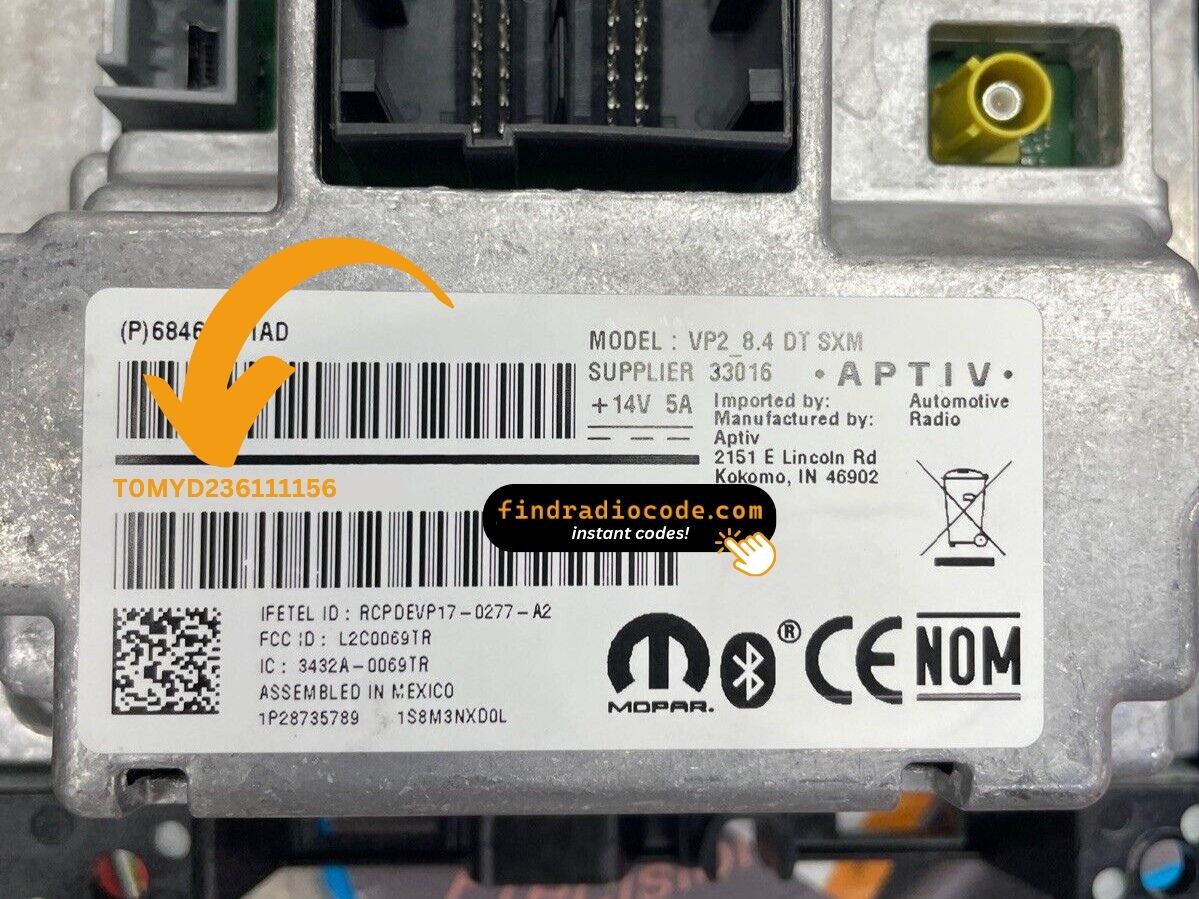
Example: Dodge Challenger serial number label location
Typical Radio Serial Prefixes and Formats
Common radio units in the 2013 Dodge Challenger and their serial formats:
- MyGIG REP 430 (non-nav touchscreen) – Serial prefix:
TM9 - MyGIG RBZ 430 (6.5" touchscreen) – Serial prefix:
TM9orT00AM - MyGIG RER 730N (navigation) – Serial prefix:
TM9 - RES 130 (base CD/MP3) – Serial prefix:
TM9orT00AM
All serials are 14 characters. Ensure to use the serial number, not the part number (P05064... or 68...).
Typical Serial Number Examples for 2013 Challenger
For the 2013 Dodge Challenger, the factory radio you find on the chassis is one of three head units: the base RES single-CD/MP3 receiver, the RBZ MyGIG 430 without navigation, or the RHB MyGIG 430N with Garmin navigation. Each one prints its serial number on a label attached to the metal casing, normally next to a barcode and the Mopar part number.
On the RBZ and RHB MyGIG units, the serial is most commonly seen as a string starting with the letter T followed by additional alphanumeric characters, with a total length around fourteen characters. A frequently observed pattern on community forums uses a T00 lead-in followed by two letters and then a sequence of digits and letters. The string is printed in upper case directly on the chassis label.
The base RES receiver also carries an alphanumeric serial on its label, but the exact prefix used on the 2013 Challenger is not consistently documented in public sources, so the safest approach is to read the actual sticker rather than assume any fixed pattern. In all cases, the value to use for a code lookup is the one printed next to the words Serial or S/N, not the Mopar part number that typically starts with P05 or 05. If the label is difficult to read, photograph it under good light so the characters can be confirmed before submitting the serial for a lookup.
How Serial-Based Dodge Challenger Radio Unlock Works
To get the code, you'll take only 4 easy steps.
- Find the radio's serial number - this is the only info required by our side.
Unlike when contacting the dealer, no VIN or paperwork is needed. - When you've found the S/N, type it into the form above.
Our system checks it against a database of supported units and automatically finds the matching radio code. - In most cases, the code will appear instantly on the screen after you pay and is also sent to your email , just in case.
If manual verification is required (rare situations), you'll be informed before checkout. - Once you get it, simply enter it into the radio to restore full functionality.
Code Entry Instructions
After locating the serial number and retrieved the unlock code, the next part is entering it into your radio.
Dodge factory radios display a CODE prompt when ready for input.
The process is quick, but button layouts and confirmation methods may vary depending on the radio version installed in your Challenger.
Step-by-Step - The Correct Way to Enter It
Entering the unlock code on the 2013 Challenger's radio:
- Turn ignition to ON. The radio displays "CODE" or "ENTER CODE".
- Touchscreen models (REP/RBZ/RER): Use the on-screen keypad to enter each digit.
- Non-touchscreen models (RES/REF): Press preset button 1 multiple times for the first digit, button 2 for the second, 3 for the third, 4 for the fourth. Hold Enter/OK to confirm.
Warning: 3+ wrong attempts trigger a lockout. Keep the Challenger's radio powered for about 60 minutes to reset it.
In-depth Entering Instructions for Challenger 2013
On the 2013 Dodge Challenger, MyGIG head units (RBZ and RHB) commonly prompt for a four-digit anti-theft code after the battery has been disconnected or when a radio has been fitted to a different vehicle than the one in which it was originally paired. The base RES receiver does not generally display a code prompt under normal operating conditions on this model year.
Before entering anything, take note of the limited-attempt warning that applies to all MyGIG units of this era. The radio permits only a small number of code attempts in succession; after three failed entries, the unit enters a wait state and refuses further input until a timer counts down. To avoid this lockout, double-check that the code you have was generated against the exact serial number printed on the radio's chassis label before typing anything into the head unit.
To enter the code, place the ignition in the RUN position so the radio fully powers up and completes its boot sequence. When the screen shows an anti-theft prompt such as Please Enter Anti-Theft Code or simply the word CODE, use the numbered preset buttons across the faceplate to enter each digit of the code in order, treating each preset as the matching numeral. If the entry is accepted, the prompt clears and normal audio operation resumes.
If the code is rejected, stop after the second failed attempt and recheck the serial used to obtain the code. If the screen shows a wait or timer message, leave the ignition in RUN and let the countdown finish before trying again, since powering the radio off and on does not normally clear the timer. After an extended lockout, you may need to leave the key in the RUN position for up to an hour before another entry will be accepted.
Understanding Unlock Issues with Your Challenger
The Challenger's MyGIG radio must be removed to access the serial label, as older platforms lack on-screen display. On the label:
- Serial number — 14 characters, starts with
TM9orT00AM. Use this. - Part number — prefixed by
P05064or68. Do not use.
Copy all 14 characters carefully — similar-looking characters are easy to mix up on printed labels.
When no "CODE" screen appears after a battery event:
- Ensure the ignition is in ON (not ACC) and wait 15–20 seconds to initialize.
- Inspect the radio fuse — a blown fuse prevents the radio from displaying anything.
- On some older units, pressing any button on the radio face activates the code prompt.
If the radio stays dark, a blown fuse is the first thing to check.
How you enter the code on the Challenger depends on which radio is fitted:
- Touchscreen models (MyGIG REP 430, RBZ, RER 730N) — Use the on-screen number pad. The display confirms each digit as you enter it.
- Non-touchscreen models (RES 130, REF) — Press preset button 1 cycling to set the first digit, button 2 for the second, 3 for the third, 4 for the fourth. Then hold Enter/OK to confirm.
If unsure which type you have: a touchscreen means touchscreen entry; a black physical display means preset buttons.
Code rejection on the Challenger's MyGIG or early Uconnect almost always means the wrong serial was submitted. The label shows both a serial number (TM9 or T00AM, 14 characters) and a part number (P05064... or 68...) — only the serial generates the code.
Look at the sticker again and contact support for a free re-check if needed.
After 3 wrong entries on the Challenger's MyGIG, a 60-minute lockout takes effect. The display will show "WAIT":
- Leave the radio powered — ignition stays in ON, engine off is fine.
- Wait the full 60 minutes.
- Cycling the ignition resets the timer.
Once clear, re-enter the code carefully.
What Caused the Radio to Lock?
2011–2013 Challenger owners encounter this primarily due to:
- Seasonal storage — Many Challengers sit over winter, draining the battery enough to activate the anti-theft.
- Battery disconnect or replacement — the primary trigger on pre-2014 Challengers.
- Blown fuse — a blown radio fuse also counts as a power loss.
- Used purchase — buying these used often means the code was never recorded.
The unlock code is tied to the radio serial and does not expire.